Soak me in your laundry and I’ll come out clean, scrub me and I’ll have a snow-white life. Tune me in to foot-tapping songs, set these once-broken bones to dancing. Don’t look too close for blemishes, give me a clean bill of health. God, make a fresh start in me, shape a Genesis week from the chaos of my life. Don’t throw me out with the trash, or fail to breathe holiness in me. Bring me back from gray exile, put a fresh wind in my sails! Give me a job teaching rebels your ways so the lost can find their way home. Commute my death sentence, God, my salvation God, and I’ll sing anthems to your life-giving ways. Unbutton my lips, dear God; I’ll let loose with your praise.
When I was a beginning, baby beader, I didn’t know that there are many brands and qualities of beads, so I have acquired a plethora of beads; some better than others. In the midst of Day 1 of Contemplative Knitting Beading, reflecting on Julie’s thoughtful commentary about what God needs to pull out of us, to unknot, to remake. . . . I was working on one of several unfinished projects through which I will pray this Lent. These beads are not of the highest quality. The sizes are uneven, making them unsuited for any number of designs. They are – horror of horrors! – imperfect. They are imperfect like me. They don’t fit together well, like I rarely fit with other people. Like Mr. Darcy of Jane Austen’s Pride and Prejudice, “I am ill-qualified to recommend myself to strangers.” – or even to myself at times. They are misfits.
But I committed this Lent to opening my heart to the work of God through this attentive, contemplative process, to listening to whatever parable might surface from the work in front of me, so started once again on this simple, twisted necklace which doesn’t require perfect beads to be attractive. It requires some patience and a little concentration, but allows inner stillness and listening. Maybe I should have chosen a more complex project that blocks inner listening, because what I heard made me uncomfortable. A very Lentish start to Lent.
“If you can find a use for flawed beads, what makes you think I can’t find a use for your flaws?” “Instead of falling into the trap – again – of trying to change all the things you don’t like about yourself in six short weeks, why don’t you accept that I love you and am working within you and that you have much to give because I gave it to you?” In other words, get over yourself. Or something like that.
Beading can be graciously humbling. Each new technique has to be learned slowly, carefully. Even when you think you finally have the new method in your fingers, you can find yourself frogging, re-doing, re-learning over and over. Sometimes you just have to set it aside, (I can be grumpy and self-pitying about that.) Sometimes you pick it up, try again and set it aside again. But eventually something “clicks” and you wonder what the fuss was about.
Here’s my guess. The grace is in the “fuss”. It’s in the struggle, frustration and pricked fingers. It is in slowing down, “listening to the beads” as one teacher put it. It’s like trying to do pray “right” instead of receiving prayer as a gift and knowing that the prayer is more in being present, struggling to focus, failing and trying again, even choosing to endure boredom than in those fleeting moments of . . . something. The wisdom of Leonard Cohen sums it up:
“Ring the bells that still can ring.
Forget your perfect offering.
There is a crack, a crack in everything.
That’s how the light gets in.”
Bio – Sister Diana Doncaster, aka the nun2good, is an Episcopal priest and member of the Community of the Transfiguration in Cincinnati, Ohio. Once upon a time, she was given a a lovely, simple seed bead bracelet. That was all it took. She had to figure out how to make it. She discovered Pinterest. She discovered Facebook beading sites. She met a friend who taught her new stitches. But a Sister vowed to poverty, chastity and obedience must have a good reason for creating jewelry. After all, she wears a habit most of the time (except while in isolation during COVID which just goes on and on and on.) So since she has long been sold on the idea of micro-loans and micro-finance as superb ways to help people help themselves, she decided that any proceeds from selling her beadwork will go to Episcopal Relief and Development’s Microfinance program. https://www.episcopalrelief.org/program/micro-finance/ She continues to live in that odd space among three mottos: “Benignitas, Simplicitas, Hilaritas” (Kindness, Simplicity, Joy), the motto of the Community of the Transfiguration; “There is no such thing as too many books or beads”; and “No outfit is complete without cat hair”. That last is the gift of her feline companion, a Siberian Forest cat named Motka who loves to “help” with just about everything.
Project Update: Pattern rows 3-10 of Pattern #56 Japanese Stitch Bible
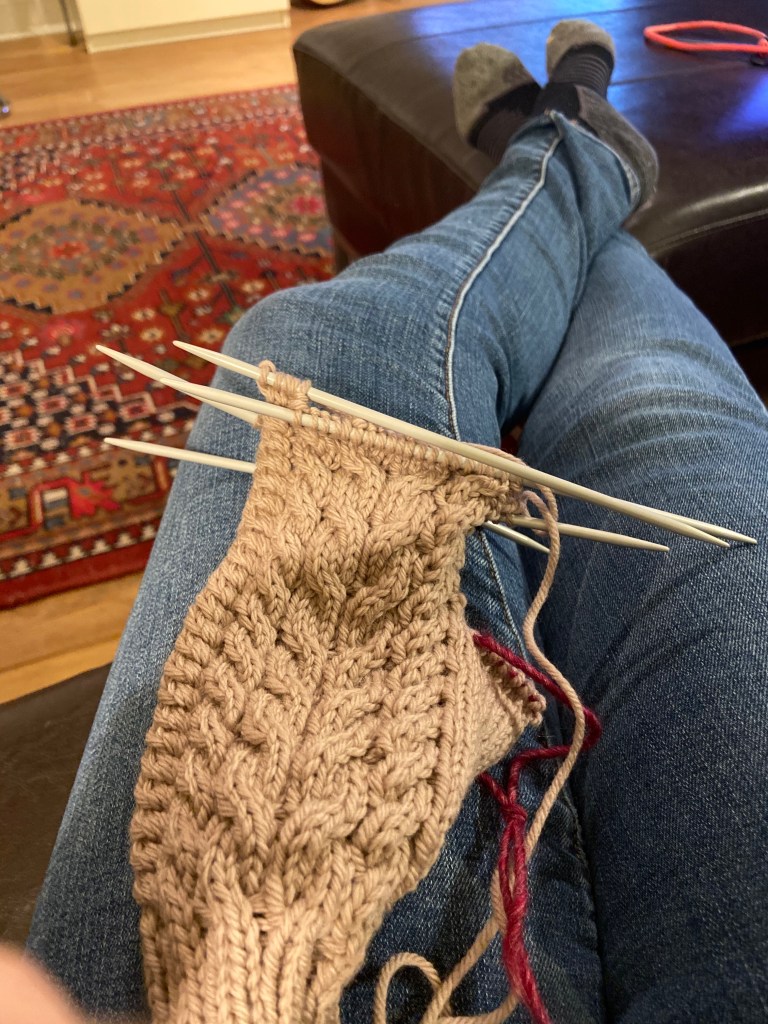
I have knit socks in the past. My first pair of socks were tube socks which don’t have a heel but are knit in the round until they are deemed long enough to start the toe decreases. The kirchner stitch is used to join the stitches at the toe. This was over forty years ago. I was working as a nurse’s aide on the night shift in an extended care facility with another aide, Lila and a registered nurse, Sarah. Lila and Sarah would sit and knit in between bed checks and Lila made tube socks by the dozens. She taught me using four double pointed needles and she wrote out the directions for the kirchner stitch.
I came across Lila’s handwritten instructions in an old knitting bag recently. I remember knitting through the January nights during my semester breaks from college. The three of us sat in the dimly lit nurse’s station, our heads bent over our knitting, the wards quiet and still our needles clicking away. We didn’t talk much but one of us would mention that Mr. Lewis didn’t seem to be doing well. We would nod, and then knit for a while. Sarah would say, maybe we could try elastic stockings on his legs to make him more comfortable and Lila would write a note in his chart and we would all go back to knitting.
Knitting was our prayer for those in our care. We didn’t need to say much. We were all in the same space, focused on the person we had decided to bring up to the group. Knitting was the context of our conversation, the calming medium that allowed us to figure out new ways of caring for our patients.
It was an exciting night when I had finally decreased to the point where I was ready to join the remaining stitches and make a toe. Lila lined up an equal number of stitches on two doubled pointed needles. She threaded a needle and started going in and out purlwise and knitwise. This is how you join the two sides together, she told me. You do it with patience and love. I still feel her breath on my cheek, her face close to mine, and I hear her calm soft voice coaching me how to close the gap. It was that same calm voice that would whisper soothing words to the patients that were in hospice care. Many nights she would station herself next to the bed of someone who was close to dying. I would join her in her vigil, and we would knit silently, getting up to make sure the person was comfortable, changing sheets, adjusting blankets, and simply being present. Our knitting kept us present.
Lila and Sarah had been working at the Extended Care Facility for years. They had adapted to working the 11pm to 7am shift. Their knitting was their prayer, their way of being present, and their way of helping me become aware of how I could close the gaps of loneliness for others by being that calm quiet presence.
Project update: 4 rows of seed stitch and 2 set up rows and Pattern rows 1-2 of pattern #56 Japanese stitch bible.
I struggle with contemplative practices. I am fairly good at being silent, being still, being solitary. I am an extreme introvert, after all. My thoughts, though. They scurry and rabbit around like, well, rabbits. One thought can produce ten more, and off I go, sitting silent, still, solitary, but planning the next day’s meals and must-dos, mulling over yesterday’s missteps, and wondering what time it is right now.
In my hospital chaplaincy work, I have learned to be comfortable with silence, with stillness, with sitting with someone who is grieving the sudden loss of life or of an old, long-lived way of life. I have learned to train my rabbit-y mind to attend to the details in front of me, to be very present in the moment, to hold space for whomever and whatever. When I am alone in my meditation space, however…Yikes!
This Lenten season, I am striving to provide the same unconditional positive regard that I give my patients to myself. When I sit in my meditation space, I am bringing a mind that will keep traveling far from center. Knitting helps me maintain a center in my contemplative practice. There is so much to be present to with knitting: the sound of the needles against one another, the softness of the wool, the warmth of the steadily growing garment in my lap, the colors and how they play together, sometimes even the musky smell of lanolin.
As I knit, stitches moving from one needle to the other, the yarn flows up from the yarn-keeper at my feet. To one side, my right, I have an imaginary basket. There is another to my left. When a future-based rabbit-y thought scurries through my mind trailing its prodigious progeny behind, I settle it all in the right basket. When a past-based thought does the same, I settle it to my left. There is no wrong, and no right here. They just are. Some mornings the baskets fill to overflowing, and that is okay. Those rabbit-y thoughts can wait. And when I approach my meditation time with gratitude and these intentions, and pray that I will allow the same space to myself that I would give a patient, I often end with a sense of sanctuary that I can carry with me into my work.
On the needles
Garden Variety shawl by Lisa K. Ross, knit in succulent colors with Miss Babs Yummy 2-ply Toes.
Bio
Patti is a deacon in the Episcopal Diocese of Rochester, NY, and a per diem chaplain at three area hospitals. Currently, she is a full-time student at Colgate Rochester Crozer Divinity School, working on a master’s degree in Religious Studies. In her spare time (and during some classes), she knits.
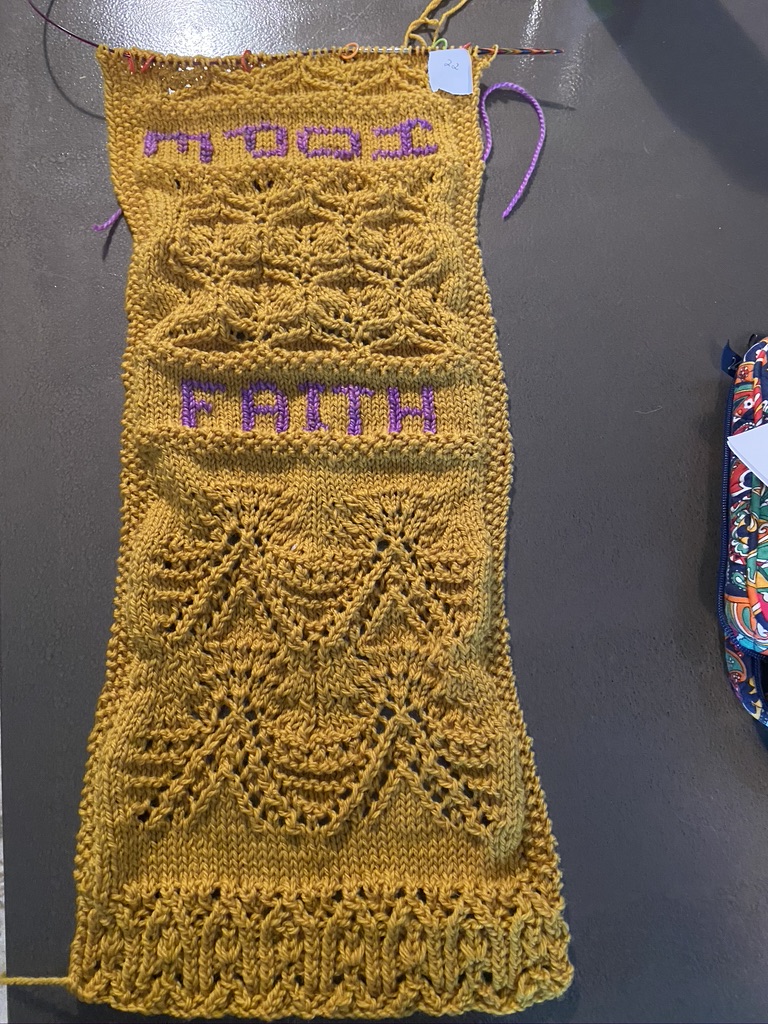
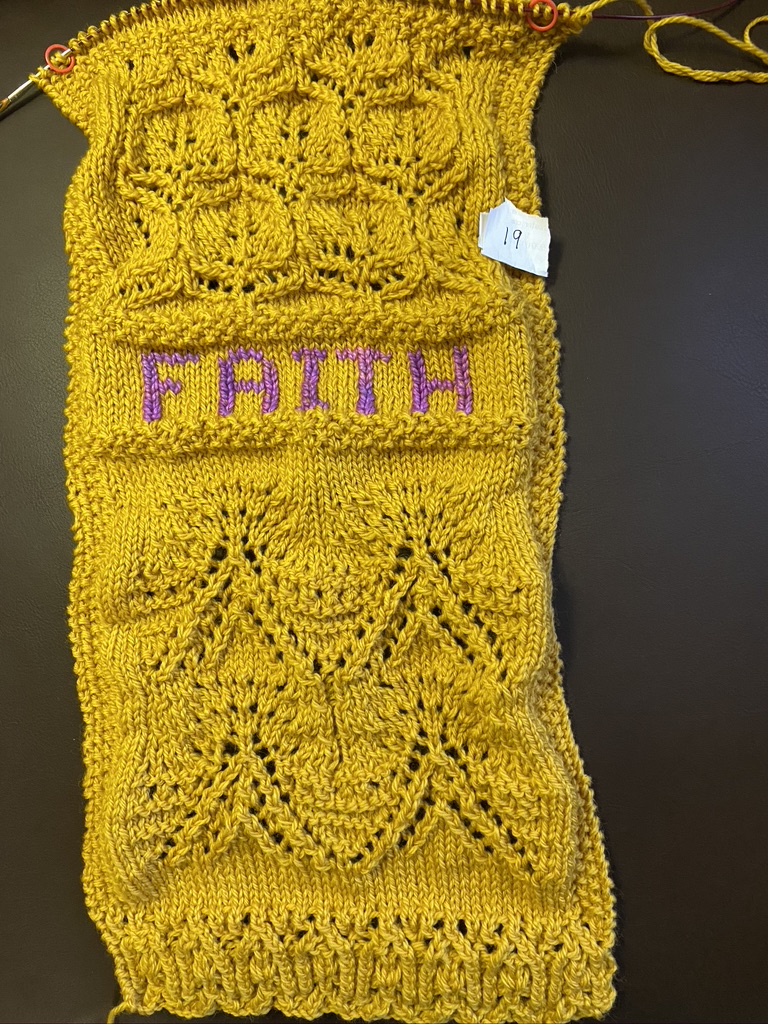
Project Update – 8 rows of Stockinette and the word Hope using duplicate stitch
My Aunt Rose was a knitter. I called her Aunt Rose because my parents had been best friends with Rose and Don before I was born. I grew up calling them Aunt and Uncle. We spent many weekends together during my childhood hiking and skiing together. Rose and Don had three children and there were three children in my family. The six of us kids got along, and we loved having this extended family.
It was Aunt Rose who called my mother every morning after my Dad died to check on her. They would chat and talk about their knitting. They even did a knit along together, just the two of them. They knit the Great American Aran Afghan. My mother knit hers in a light green and Rose made her in a deep red. Each square had a unique set of challenges and they helped each other figure out the difficult stitches.
Rose was knitting an afghan for her oldest granddaughter, Christine when she found out she had pancreatic cancer. She was a little over halfway done when she died. Rose’s daughter shipped the Afghan off to my mother in hopes that she might be able to finish it but it stayed in the bag. I asked my mother about the afghan when I was visiting her. She got it out and it made us both very sad. I couldn’t stand the thought of Christine not getting this gift from her grandmother. I treasure the afghan from my grandmother.
I took the afghan home. When I got it out, I saw that Aunt Rose had kept careful track of her pattern rows. The afghan was a brown wool and had a diamond stitch pattern. Meticulous pencil marks in a little notebook stuck in her knitting bag guided me to the exact spot where she had left off. The pattern was fairly easy, but I hesitated. How would Christine know what her grandmother had knit and what I had knit? Did it matter?
It did to me. I would want to be able to touch the stitches and know what my grandmother had done so I started knitting a different pattern. I stayed with it until it was the size the pattern had designated. I shipped it off to Christine’s mother who gave it to her daughter for her college graduation.
Christine wrote me a note that I still have expressing her appreciation for the decision to knit a different pattern. She can physically touch the stitches that her grandmother knit just for her. She will always treasure that last gift from her grandmother.
Aunt Rose is gone but the love she put into each of those stitches is still present. Christine may no longer be able to hear her grandmother tell her I love you but her grandmother’s love is still tangible and transcends time and space through her knitting.
As we sit and pray with our knitting, as we feel the softness of the yarn, the polished needles creating the stitches, we can think about the love that is available to us from God and how each stitch creates a fabric that can warm and comfort those we love. As knitters, we make love tangible.
Project Update: Pattern Rows 3-10 of Pattern 56 from the Japanese Stitch Bible.
Why do we make things? What have we lost with our increasing isolation from the physical world and the skills that have allowed us to flourish within that world? How do we reconnect with our bodies, the earth, and one another? How does the act of making things change us, help us grow, heal us? These are all spiritual questions, and their answer is also spiritual. Making things is an inherently spiritual activity. It immerses us, whether we are conscious of it or not, in the deepest questions of human life. Like any contemplative practice, craft encourages us to slow down, to connect with our bodies, and to enter a state of timelessness or eternity in which we cease to strive, even as we work for an end. The process of making something, beginning with raw materials, engaging our senses and abilities—and our limitations—and following through until we have a finished piece is itself a spiritual inquiry into the nature of reality and the nature of the self. Put more straightforwardly, when I make something, I discover more about who I am, which includes a deeper understanding of the world in which I live. That this knowledge is usually intuitive and implicit rather than explicit makes it no less transformative.
Craft is also an inherently religious activity. The word “religion” derives from the Latin “religare,” which means “to bind together.” In the same way a physician binds a wound, craft, when engaged in as a contemplative practice, binds the fragments of our many selves into one unified Self. Vigen Guroian, an Orthodox theologian and gardener, puts it this way: “When I garden, earth and earthworm pass between my fingers, and I realize that I am made of the same stuff. […] Man is a microcosm in whose flesh resonates and reverberates the pulse of the whole creation, in whose mind creation comes to consciousness, and through whose imagination and will God wants to heal and reconcile everything that sin has wounded and put in disharmony.” (Inheriting Paradise, p. 7)
When I knit (or sew, or garden, or pray) I am remade and renewed. I am religioned—bound back together again—and made more whole in the process. Through contemplative crafting, I learn that identity is not something I create. It is something I allow to emerge, seemingly all of a sudden, until a beautiful pattern makes me laugh out loud with joy. Lent needn’t be a dreary time. Joy is perfectly wonderful way to pray and prepare!
There is a lot we can learn about ourselves when we examen our stash. Believe it or not, there are some people who don’t have a stash. A friend of mine just buys enough yarn to complete a project. She knits up the project, sews it together, blocks it and then may wait weeks before purchasing more yarn for her next project. I think she is in the minority!
I have found that my stash has changed through time. Ten years ago, it was all WIPs (works in progress). I loved to buy yarn for the latest coolest sweater in the Vogue knitting magazine. In the full bloom of my excitement, I would cast-on and knit like crazy until I saw the next greatest sweater that I couldn’t live without. My friends would ask me what my latest sweater passion du jour was. When I began running out of storage room and project bags, I counted up my WIPs and I had 25 projects on the needles. My husband started to catch on and asked me “Don’t you ever finish anything?” Fortunately, five of the projects were fairly close to being done, so I finished them in quick succession.
Then I started collecting yarn without a project in mind. I made some poor purchases because I ended up with useless quantities of yarn – not enough for a project or way too much.
Yarn is my happy place. I love looking at it, feeling it, and creating with it. However, when my stash got too big it made me anxious. I knew in the back of my mind that I was not going to use the boucle yarn in the back of the closet. I had made one sweater out of it and I probably had yarn for two more. I did not enjoy knitting with boucle because my needles kept getting caught in the little loops of the yarn. There were other piles of yarn that I knew I was not going to use. Why was I hanging on to it?
This was a good question to ask myself. Here’s what I found out. I didn’t want to admit I had made some mistakes in my purchases. I wanted to think I would have enough time to knit all those projects. I love being surrounded by yarn. I want to knit beautiful sweaters out of fingering weight yarn, but I just don’t have the patience. I can’t knit the second mitten because the tension hurts my hands and I don’t want to admit it and so on. It’s important to take time to reflect. Our collections tell us something about ourselves. It’s good to approach what we have with an attitude of curiosity. What does this tell me about myself? What kind of action do I need to take if any? How are my collections a reflection of what’s happening to me spiritually?
I had reached the point where I needed to do something. I put Marie Kondo’s strategy to use and went through my stash. Any yarn I was not in love with went into one pile and the projects and yarn I was willing to commit to went in another pile.
I took some beautiful and expensive yarn to Sew Green.
“SewGreen@Rochester, Inc., is a 501c3 dedicated to rescuing for reuse of everything to do with sewing, knitting, crochet, and needlework. The second half of our mission is to educate folks of all ages and walks of life in all varieties of creative and practical machine and hand needle arts. SewGreen teaches low cost classes and camps in our shop and has many free club opportunities for the community. We take programs out to schools, libraries, and festivals, and we are determined to revive these skills which as much as they are practical, are also good for our emotional lives
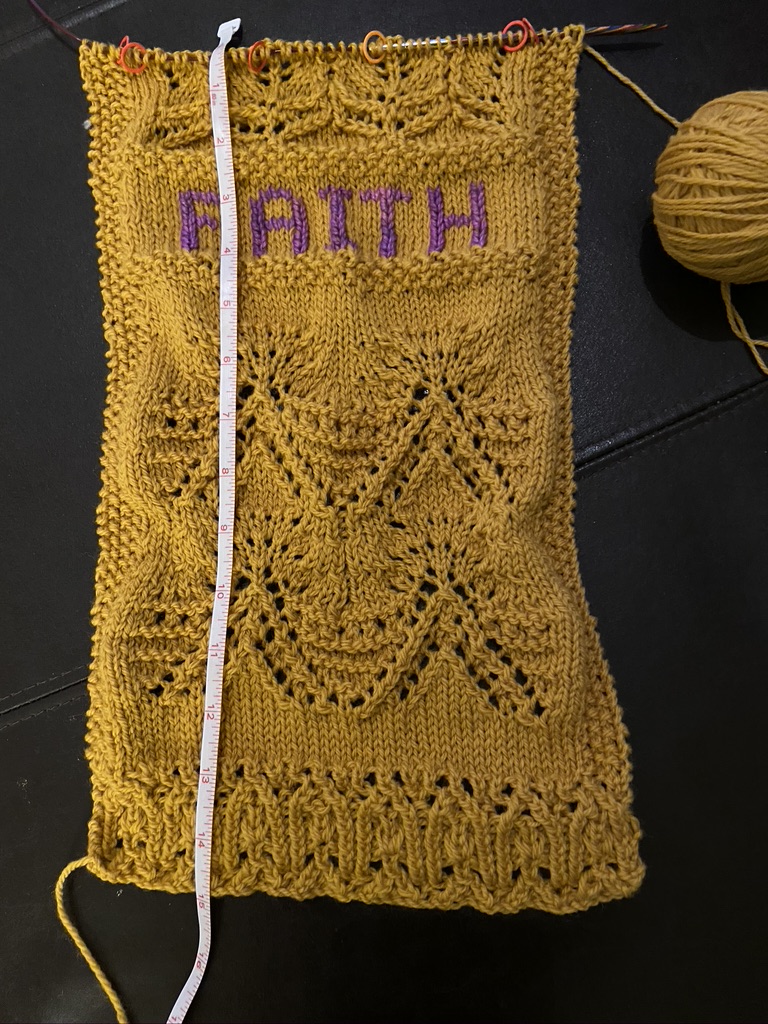
Project Update: Pattern rows 23-28, 1-2 of Pattern 56 of the Japanese Stitch Bible.
139 1-6 God, investigate my life; get all the facts firsthand. I’m an open book to you; even from a distance, you know what I’m thinking. You know when I leave and when I get back; I’m never out of your sight. You know everything I’m going to say before I start the first sentence. I look behind me and you’re there, then up ahead and you’re there, too— your reassuring presence, coming and going. This is too much, too wonderful— I can’t take it all in!
My grandmother used to knit me sweaters and make me clothes. As I recall, I didn’t like the clothes she sewed. She was an excellent seamstress, but the clothes tended to be frumpy. I remember a brown corduroy jumper (a dress with no sleeves that required a blouse underneath) and an orange floral blouse. She had made a chocolate brown cardigan with cables to go with it. I hope I was polite when I opened the gifts, but I remember thinking “I have to wear that?”
My father was an only child and I’m sure my grandmother was thrilled to finally be able to sew and knit for a little girl. I imagine her now (as a grandmother myself) sitting at her sewing machine, taking care to create the perfect garment or sitting at night in her rocking chair, guiding the cable needle in and out of the tiny stitches. She worked hard on these gifts all for a little girl who did not appreciate her efforts. She complained about my lack of enthusiasm to my parents and eventually she quit making me things.
These memories came flooding back after I gave a knitted gift to someone. They said the right things, but I didn’t get the reaction I wanted. I tried to be an adult and tell myself that the person had no idea of the hours that had gone into the project. They were not a knitter and garments like this were readily available in any department store. For a while, I was angry and disappointed until I realized this was my problem. I needed to let go.
Giving a gift is about letting go. Once the gift is given, it belongs to the receiver. A quilter I knew gave away a quilt to a friend only to find it lining the dog’s bed when she went to visit. When I asked her if that bothered her, she laughed and said no. I gave it to them, and they can do whatever they want with it. She had let go.
The spiritual life is about letting go. As Thomas Kemp put it in the “Imitation of Christ”
“To sum up, dear friend of Mine, unclench your fists, and let everything fly out of your hands. Clean yourself up nicely and stay faithful to your Creator.”
I love the image of things just flying out of our hands. I love the idea of making a gift for someone with no expectation. I want to be able to hand it over like my friend the quilter. This will take some continued prayer and work on my part.
I take my granddaughter with me to the yarn store. The pattern I picked out was a beautiful brown with cream lace around the cuffs and waist. My granddaughter wanted pink and purple. She got pink and purple.
I’ll end with this note to my grandmother. Something I should have written long ago.
Dear Grandmother,
Thank you for spending hours creating beautiful and exquisite garments for me. I had no idea how difficult it was to sew and knit. I didn’t appreciate the gifts back then, but I do now. You may have thought they didn’t mean anything to me, but the memory was there and now that I’m a grandmother, I finally get it.
Love, Julie
Project Update: Pattern Rows 15-22 of pattern 56 of the Japanese Stitch Bible
Every knitter has experienced the feeling of angst when they discover a dropped stitch. It’s even worse when you have been knitting for years. Beginners are expected to drop stitches and it’s a wonderful teaching moment when you can teach a new knitter how to “ladder up” the dropped stitch and fix the mistake. But after fifty years, discovering dropped stitches in almost every project you have on the needles can give a knitter pause. What’s happening??
A few weeks ago, I noticed a hole in my work. I just picked up the stitch and moved on saying softly to myself, don’t worry, it happens. The next day, I found another dropped stitch in a different project. This time, I paused and wondered why I dropped the stitch, but I quickly became distracted trying to find a cable needle the right size in order to grab the loose stitch. The next incident involved a dropped stitch in a fair isle project. This is what finally got my attention. The stitch had wandered down a few rows and I had to figure out which yarn on the ladder was the float and which yarn was the correct color for the pattern. This was not a fun process.
I had no idea why all of a sudden, I was starting to drop stitches on a regular basis. Did I need new glasses? I decided to pay more attention to my knitting. I forced myself to slow down and watch my hands. It happened. I saw my needle go in-between the stitch I was going to knit and the stitch next to it. The yarn went around the needle came through the hole and I pushed the unknit stitch off the needle essentially dropping it. I was missing the stitch, but my hands were making the motion and if I was looking away, it felt like I had knit the stitch. Why had I started to knit in-between stitches? Why was I missing the loop?
I think it’s because I’m using size 4 US needles and fingering weight yarn. These thin pieces of yarn require the knitter to aim. My knitting was asking for my attention.
When we sit down to pray our intention is to spend time with God. Just like with any other relationship, we need to be attentive during that time. We need to listen. The dropped stitch is a good example of what happens when our attention drifts whether it is in our everyday lives or during our prayer time. We drop stitches and then the fabric of our lives is weakened. There are holes that can become larger if they are not addressed immediately. We miss the stitch entirely and then it is gone.
There is so much clamoring for our attention. People, projects, chores, children, ideas, work, and even yarn! There is so much content out there. It’s everywhere inviting us to look away from our focus.
Being in silent prayer can help us learn to focus our attention again and that focus will translate to the people we love. There is no greater gift in any relationship than being truly attentive.
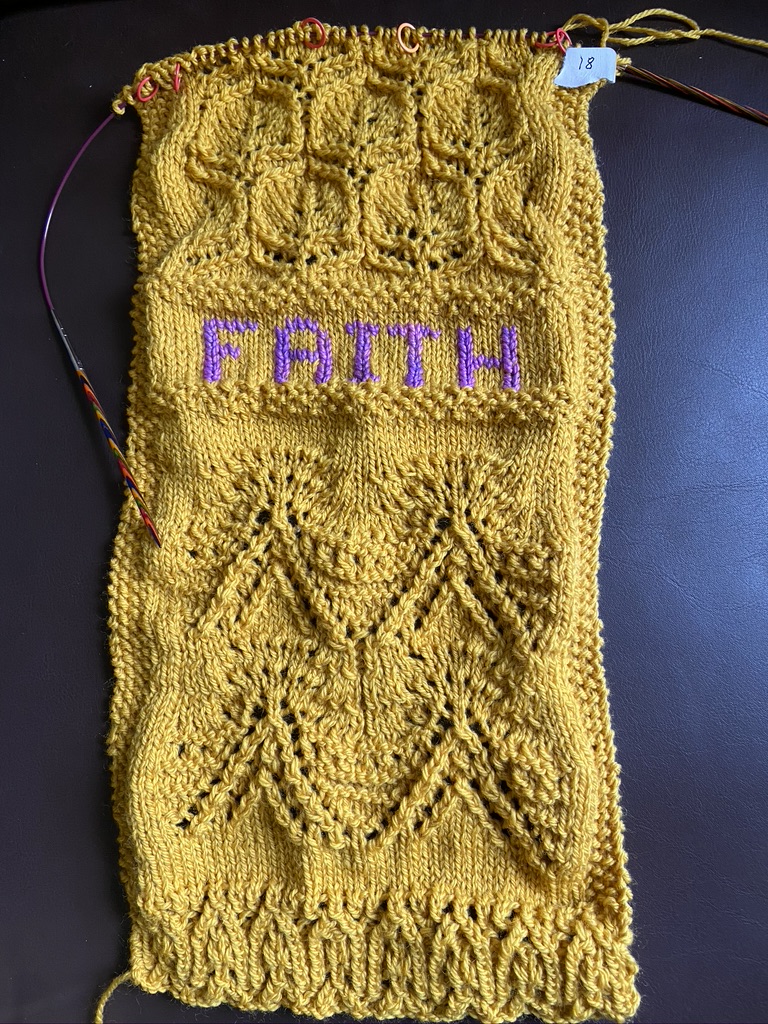
Project Update: Pattern rows 7-14 of Pattern #56 of the Japanese Stitch Bible.





 Contemplative Knitting