Mittens in the Snow

Image by Jill Wellington from Pixabay

     Unexpected gifts give unexpected energy to the receiver.  A few years back, a gift certificate to my favorite independent bookstore arrived in the mail.  I had no idea who had sent it. When I went to the store to browse, I asked the owner who it was from.  She just shook her head and told me that the giver wanted to remain anonymous.  Well, who am I supposed to thank? I asked.  She smiled and said, everyone!  Treat everyone like the giver.

     Anonymous gifts of knitting spread love and beauty into the world and there are many stories of knitters providing chemo hats, shawls, baby blankets and all sorts of beautiful handmade knitted items to all kinds of organizations but one knitter’s mittens really struck home.  This knitter made mittens and left them in impoverished areas of the city.  She spent hours crafting the most intricate and beautiful designs for the adult mittens and warm fuzzy bright colored mittens for children.  She would encase them in a clear plastic bag and nail them to trees or duct tape the bag to a park bench with a note asking who ever found it to consider the mittens a gift. 

            I met a woman at our food pantry who had found a pair of gift mittens.  Even though it was cold, she wasn’t wearing them.  She had them in her purse, still in the bag.  She took them out to show me like she was a museum docent showing me an item from her most prized collection.  She marveled at the intricacies of the pattern and since she knew I was a knitter, she asked me “do you know how to this?”  I told her I knew how to do the colorwork but I was in awe of intricacies of the pattern and the hundreds of tiny stitches that made up the mitten.  They were exquisite.  Do you think I was meant to find them? She asked.  You found them, didn’t you? I replied.

     I saw the woman a few times more times that winter.  On a cold day in March, I asked her about the mittens.  She took them out of her purse.  They were still in the original plastic bag.  I asked her why she wasn’t wearing them.  She told me they were too nice to wear but they had provided her with something greater than warmth.  They had given her hope.  She realized that there were people in the world who were willing to give of themselves without receiving anything in return.  This realization had allowed her to reach out for help. She was able to make herself vulnerable.  Help was given to me, she told me and now I can move forward.  I noticed she didn’t pick up any food but just moved through the line of waiting people saying hi, offering up a smile and a handshake.  When we were cleaning up, I found a dirty white envelope.  It was full of cash with a note that said “Whoever finds this, consider it a gift.” 

     We love because he first loved us.

            1John 4:19 NRSV

Project Update

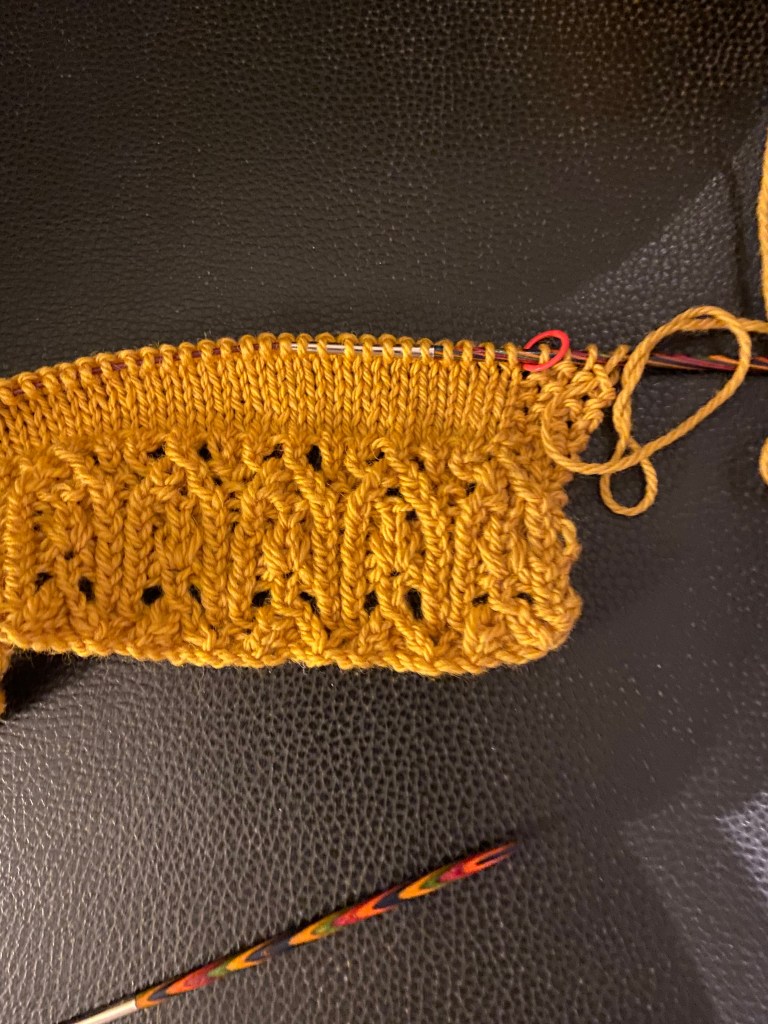
Rows 8-16 of pattern #26 from the Japanese Stitch Bible

The Power of Language

I love the names of colorways.  I was perusing the Magpie Fiber website recently in hot pursuit of the yarn “London Rain” that Joji Locatelli used to make her Lightweight Hipster shawl and then I saw “Paris Train” and “Wood Smoke” and “Smoke on the Water.”  I noticed how the names of the yarn caused an immediate emotional connection.  I could feel the London rain, smell the wood smoke, see the gray mist rising up from the water and picture myself on that fast train to Paris.  Language has power.

     Saying something out loud gives it power.  When we say it to another person, it takes on even greater power and when we write it down and read it over and over, we start to believe it. 

            For the longest time, I had a friend who believed that God would never love her.  She had done something in her younger days that she considered unforgivable.   I tried to convince her about the mercy of God, but she just kept insisting that she was not worthy of forgiveness.  I couldn’t imagine.

     I was successful getting her to church.  She would come and listen and sing the hymns.  Her voice had a depth to it, a resonance that reminded me of two strings on a cello being played together.  She refused to join the choir, but to my surprise the choir director convinced her to sing a chant based on Psalm 51 at one of the Lenten services.  The choir director had written a melodic chant especially for her voice.

     The night of the service, my friend stood in the center of the church holding a candle and started chanting:

“Have mercy on me O Lord, according to your loving kindness, in your great compassion blot out my offenses, wash me through and through from my wickedness and cleanse me from my sin.  Create in me a clean heart, O God.”

     She stopped, tears streaming down her face.  There was a long moment of silence before she began again.

      I asked her later that night what happened?  She replied, when I started singing, I felt this overwhelming feeling of forgiveness wash over me just like the words in the Psalm.  I didn’t ask for it, but it happened just the same.  It was the words, the music, the people, all in the moment that finally cracked her heart open.

     That moment of healing was just the beginning.  She wrote the first few verses of Psalm 51 on a piece of paper and stuck it up on her bathroom mirror where she could read it every day until finally, she believed.

Project Update

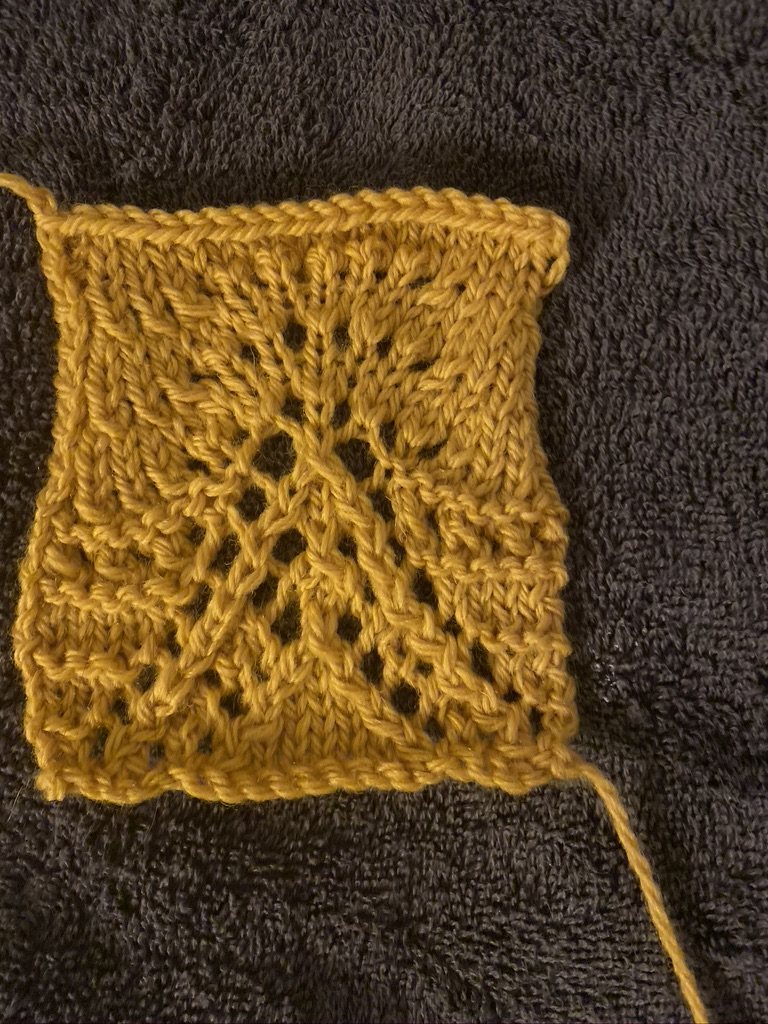
Rows 1-8 of Pattern #26 from the Japanese Stitch Bible (I did 1 inch of stockinette yesterday)

The Knitting Community

 I usually follow a pattern when I knit, and I like to use the exact yarn and color that the designer uses.  A number of years ago, I was looking at a sample garment (Carrick designed by Martin Storey) in a yarn store in Chicago.  It was made from a Rowen soft knit cotton in a robin eggshell blue. The yarn store didn’t have enough of the blue yarn, so the owner brought out a bag of the colorway sunset red.  I couldn’t picture the sweater in red and I hesitated.  I explained to the owner that I usually bought the same color as the pattern.  She looked surprised and then thoughtful.  She told me I should give myself permission to branch out.  Make the pattern your own she suggested, and you can start by choosing a color you like.  I bought the sunset red.

We are all creators.  A pattern or a template is just the beginning.  We get to decide if we want to alter the length of the sleeves, add some waist shaping, change the collar, or add mohair to the mix.  For pattern followers like myself, Ravelry has been life changing. I have the benefit of seeing what other knitters have done with a pattern.  I get to read their notes, find out some of the challenges, see all the substitute yarns, and enjoy multiple pictures of the same sweater knit in a variety of ways.  I can choose to join them and add my own spin on a design.

Community is important and I have found the knitting community to be incredibly supportive.  If someone posts a question about a pattern, the knitters are on it. There will be multiple suggestions including YouTube links.  Even as we sit alone in our house knitting, we are not alone, there are other knitters out there willing to help.

As we knit through Lent, it helps to know we are not alone in our efforts to deepen our relationship with God.  We have each other.  What the past year has taught us is that we have to be creative with how we create community.  We may not be able to gather in physical groups, but we can use technology to transcend space and time and be in community with people who live in different time zones or even different countries.  As we start our contemplative knitting each day, we can give thanks that we are not on this journey alone.  Picture all the knitters picking up their sacred knitting and settling in to spend time with God.  If our practice becomes difficult, we can offer each other encouragement.  We can share pictures of our sacred knitting projects.  We can reflect on our experiences.  Most importantly, we can remind each other that God is on this journey with us.  God is as close to us as our very breath.  As we continue this Lenten practice, we do it with intention (we are knitting in the presence of God) and we give it our attention (we use our word to bring us back to our intention) knowing we may be knitting by ourselves but we are not alone.

Project Update

Making Sense of Symbols

     I took a class in reading Japanese stitch patterns recently.  Once the teacher explained what the symbols meant on the chart, I realized that I knew how to do most of the techniques.  It was like lace knitting but some of the symbols were different.  The class was two hours the first day and the goal was to knit two swatches.  The teacher warned us to mark up our charts so we wouldn’t “forget” that we have an edge stitch on each side of the swatch that is not on the chart and that the wrong side row needs to go from left to right and so on.

     I cast-on and went to town knitting as fast as I could so I could be on the right row for the demonstration of the “new” technique (picking up 3 stitches from three rows down…).  I didn’t mark-up my chart because I heard the teacher give the warning about what to watch out for and I thought that was enough.  You can see where this is going, right?  I forgot about the first edge stitch and when I got to the end of the row and saw that I had an extra stitch, I knew exactly what mistake I had made.

     There is so much in the world that competes for our attention.  I this case, I was anxious about keeping up with the class and being able to knit 8 rows quickly so I could knit the difficult stitch along with the teacher.  I realized I could try the stitch even though my swatch was a mess. 

     When I tried the swatch on my own, I was hyper aware of the potential mistakes I could make.  I took the time and marked up the chart. 

     I focused my attention.

     Prayer is like marking up a chart.  It focuses our attention.  It may not seem like anything is happening while we are praying but what does happen is that our level of awareness changes. 

     I remember when my friend bought a mini cooper.  It was a tiny car that I had never heard of.  All of a sudden, I was seeing them on the road.  They were always there; I just wasn’t paying attention to them.

     Prayer opens us up to the grace that is all around us but passes us by because the world is demanding our attention for something else.  Prayer invites us to “see” differently.  It starts to shift our awareness.  We go from just seeing ordinary things to seeing the Holy in ordinary things.  We have been trained to “see” our knitting. We know what to look for. Where do we find our attention as we begin this Lenten process?

Project Update

Ash Wednesday: Knitting Through Lent

Ash Wednesday – Knitting Through Lent

I’ve been obsessed with Scandinavian mittens lately.  At least this is what I called them until they started to differentiate themselves.  I love the designs.  I love how the palm side has a different pattern than the back of the hand.  When I saw a picture of the Fiddlehead Mittens by Adrian Bizilia, I knew I had to make them.   I had to make them because they had a lining.

The pattern uses an I-chord cast-on so it is easy for the knitter to pick up stitches later to knit a lining.  I chose some scratchy, warm, gold and white Norwegian yarn for the outside and a soft cushy dark blue alpaca blend for the lining.

     I loved making the outside of the mittens.  Even when I made mistakes, I found them on the next row.  The I-chord cast-on made the mittens look “finished” and I had watched enough tutorials (including one from Arnie and Carlos) about how to pick-up stitches for the thumb so there wouldn’t be any holes. 

     Knitting the lining was an entirely different experience.  I had no trouble picking up the stitches but knitting with dark blue yarn can be difficult.  The stiches were hard to see. My gauge with the alpaca yarn (needless to say) was different.  Although I did everything I could to measure accurately, the lining was messed up, the thumb misshaped, and I couldn’t figure out why.  My attitude during the time I was working on the lining was – who cares, no one will see it.  That may be true, but I quickly discovered that I could feel the bunched-up lining and the strangely shaped thumb when I put on the mittens.  I knew I had to fix the lining.

     Lent is an opportunity to fix our linings, the interior parts of ourselves that nobody sees and only we can feel when it just isn’t right.  Being uncomfortable can be a good motivator to change.  Sometimes it’s the nagging feeling right underneath the surface trying to get our attention.  It’s the grief we haven’t addressed, it’s the person we haven’t forgiven, it’s the betrayal we’re still carrying, it’s the loss of priorities, the neglected relationships, and on and on.  Although we have tried to stuff the lining into the mitten, we are so uncomfortable, we know we just have to pull it out, frog it and use the yarn to reknit our linings into a shape that we can live with.  We can do this with prayer.  We can ask for God’s help and mercy to reknit the interior of ourselves so we can reflect an authentic sense of love and peace to those who just see our outsides.

The stark reality of the imposition of ashes is a reminder of our mortality and an invitation to turn toward God.  It conveys a sense of urgency.  Lent can be a time to commit to change and transformation.  So, for forty days, we commit to a daily practice of prayer and knitting.  In this time, we will knit silently before the face of God for a specified number of rows or time and pray for the healing that comes from reconciliation for ourselves and for others.

Project Update

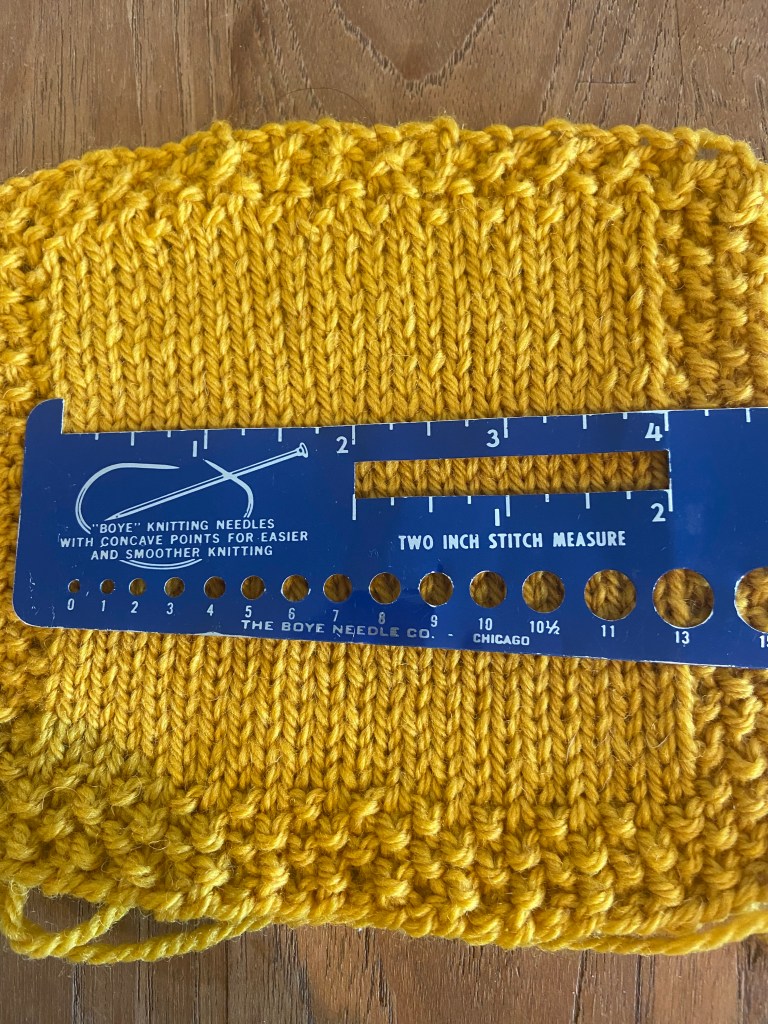
One inch knitted. Size 5 needles, 50 stitches, Tandem from West Wool, colorway Glow, Pattern 191 from the Japanese Stitich Bible.

Final Checklist for Lenten KAL

Just a few days to go. Gather your supplies, make your plan and subscribe to the blog. Every day during Lent, you will find a post about the spirituality of knitting here. Prayers ascending for all of you! See you again on Ash Wednesday!

Check List for Lenten KAL

  1. I have identified a time for my contemplative knitting practice
  2. I have found a place where I can knit and pray in peace.
  3. I have picked the yarn and needles.
  4. I have figured out my gauge and what I am going to make.
  5. I have made a commitment to Knit and pray for _______ minutes per day or _______ inches per day or ________ rows per day. (pick one that works for you.)
  6. I have written down my motivation for wanting to start a contemplative knitting practice.
  7. I have a plan for how to sustain my practice when it becomes challenging.

Some Guidelines for Contemplative Knitting

How much do knitters talk about swatching? For some of us, it’s like cleaning and sanding an old surface before applying a new coat of paint. It’s necessary but not fun. For others, swatching is their play time. Trying out new yarn, seeing how it behaves, and figuring out how to make it work in a pattern is something they love to do. In a San Francisco yarn store, I discovered balls of yarn in a huge bowl next to a vase filled with knitting needles. The owner encouraged customers to make a swatch of any yarn they had in stock. She called it a “yarn tasting”.

The majority of knitters know how important it is to swatch even if we get defiant about it. It only takes one hugely oversized sweater to understand why gauge is important.

But swatches are guidelines. More advanced knitters may decide to go “off road” and knit a sweater out of fingering yarn when the pattern calls for a DK weight because they like the drape of the fingering yarn or the color. This requires some math but it can be done. Guidelines are the beginning, they are the roadmap that help us find our own way. They give us the information to move forward or to make the changes that we want.

Here is the gauge for Contemplative knitting. What follows are some guidelines for your prayer time. They are just that – guidelines. Just as you might have to change your needle size, you will need to decide what you need to change to make it work for you. You may decide not to follow any of these guidelines. And that’s ok because there are many ways to pray.

Four Guidelines for Contemplative Knitting

  1. Choose a sacred word – Find a word or two at the most that expresses your intention to be with God. This word or words must be meaningful to you. What’s important is that you invest an importance to the word for yourself. Maybe it’s peace or shalom. Maybe it’s Yes, or Amen (so be it). As you prepare to embark on knitting through Lent try out different words and see what sticks.
  2. Ground yourself – Sit comfortable with your knitting on your lap. Feel the yarn and the needles. Bring yourself into the present moment and introduce your word. Say it slowly. Begin to knit. Find a comfortable rhythm.
  3. Let your thoughts go – Thoughts will fly into your head. I forgot to defrost the soup, what do I need at the grocery store?, has the laundry been mildewing in the washing machine for three days?, and so on. Let them go. Watch them go by like a stick on a river with a swift current. They are like birds flying into your head. Don’t let them build a nest. Don’t engage. It’s important not to get frustrated with the distractions. Say to yourself, here they come. I know you’ll be around after prayer time, I’ll pay attention to you then. Use your sacred word to bring you back to your prayer time. Say it gently and slowly.
  4. Give yourself a minute at the end – When you have completed your rows/time or however you are measuring your prayer time, give yourself a minute. Put your knitting down, take a few deep breaths, and then reenter the world.

Count Down to Lent – 9 more days!

How Will You Track Your progress?

What will you find out about yourself during the forty days of Lent this year?

     A contemplative practice not only helps us connect with God; it helps us connect with ourselves.  Each time we commit to a practice we learn something.   The important part about learning is not to become judgmental or get frustrated.  

     Nothing sends me over the deep end faster than trying a new technique.  I’ve been knitting for fifty years and I feel like I should be able to do anything by now.  However, when it takes three attempts to do a tubular cast on for a simple hat, I have to remind myself to be patient with myself!

     I’m going to suggest you create a method of tracking your contemplative knitting prayer time as a way of learning about yourself, not to make you feel anxious or guilty. Tracking commitments is critical if we want to sustain a practice.  It helps us notice when we begin to lose focus or get off track.  Sometimes trackers can be the exact motivation we need.  How many of us jumped through hoops to walk the 10,000 steps when our Fitbit or walking app reminded us that we were at 9500 steps for the day?  I had a friend who paced back and forth in her tiny New York City apartment each night just to hit her step goal. (I know, who wants to be controlled by an app! I promise I did not turn the car around on the way to the gym when I forgot my watch.)   

     There are many different ways you can choose to track your progress during the next forty days.  It could be as simple as checking off a box on your to do list or making a mark (or use a sticker) on your calendar.  You could decide to text a friend each day to let them know you finished your practice.  You could track the measurements of your project using progress keepers.  Progress keepers are similar to stitch markers but can open and close like a safety pin so they can be easily moved.

     Tracking our commitment is not meant to create anxiety or guilt.  It’s meant to help us learn about ourselves.  Getting off track is not a failure it’s an opportunity. It’s helpful to have an attitude of curiosity as we approach starting a new practice.  Each day, week, and month we can reflect back on what has happened in our practice.  Maybe we skipped three days because a family member was sick, or we were too tired, or we were too discouraged.  This is valuable information.  It means we need to spend some time reflecting on what is going on in our lives and figure out what we need to do differently.  What would motivate us to restart?  Can we put our restart plan into place? https://contemplativeknitting.com/2021/01/20/sustaining-your-knitting-practice/

     Maybe we spent more time or knit more rows or did twelve inches in the first day.  We may need to rethink what we are doing before we experience a hand injury.  What’s happening in our lives that is causing us to spend too much time on our knitting practice?  Are we avoiding something?

     We could decide that this type of spiritual practice is not for us.  Let me just get back to knitting!  That’s ok too!  There are many ways to pray and deepen our relationship with God.

     How will we track our progress?  How will we restart?  How will we all support each other? 

Planning your Project for Lent

Three weeks until Lent. There is still plenty of time to prepare your Lenten Project and to invite others to share in the journey!

     Thank you to all of you who have subscribed to this Blog.  We are two weeks away from Lent and I will be posting a few more times to answer questions and to help us prepare for our forty-day commitment of intentional prayer time with God. Starting in Lent, there will be a daily post with the exception of Sunday when we will live into a day of rest.

     Everyone is welcome to participate and here’s how.  Unlike other Knit Alongs we will not be making the same thing.  There is no set pattern for knitting, crocheting, or whatever your favorite repetitious calming pastime is.  Instead, the pattern we will be using is one of daily prayer.  So, what can you do to prepare?

  1.  Decide on a time and place to pray. (see blog post: Setting Up Your Practice)
  2. Pick a project
  3. Swatch if you need to
  4. Write down why you feel called to participate.  Put it with your project.
  5. Reach out to others you know that might want to participate and send them the blog link. (see blog post on Sustaining Your Practice)

My Project

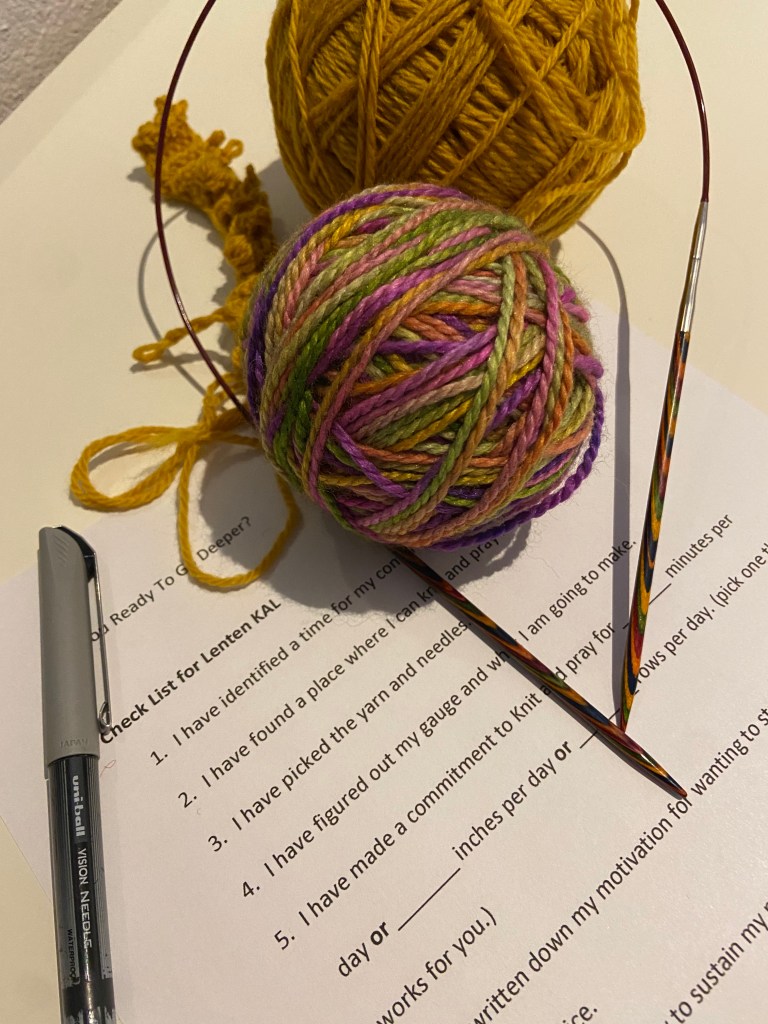
     I ordered three skeins of Tandem West Wool in the colorway “Glow” from Stephen and Penelope (a yarn store in Amsterdam. My husband and I are living in the Netherlands for a year while he helps develop a solar energy sales force for Europe.)  Tandem is 90% Falkland Merino and 10% Texel (Texel fibers have a helical crimp which give them extraordinary loft and compression resistence and come from sheep living on an Island north of the Netherlands.)

     I chose the gold color because it reminds me of sunlight and hope.  The colored skein of yarn is from my favorite local yarn store “Sticks and Cups” in Utrecht, Netherlands.  I’m going to try and use it occasionally for a color pop.

    I’m planning on knitting a long scarf and then attaching the two ends.  My step is to swatch the two yarns and decide on a needle size.  The ball band recommends a US 4 – US 7 (3.5 – 4.5 mm). I’m also looking at stitch dictionaries. Once Lent starts, let you know what I’m doing and I hope you’ll let me know how your projects are going.

     I will be winding the balls today while I pray for all of us as we get ready to support one another in our prayer practice during Lent.